
Some apps want you loud before you are ready. A circle of strangers. A prompt to practice out loud. A room where being wrong means everyone hears it.
Plenty of serious learners freeze there, not because they do not care, but because speaking is not the door they can walk through yet. They learn on a bus. In a café. At night at a quiet desk. They need somewhere that does not demand sound first.
Knowing is not the same as speaking
Knowing English is not the same as speaking English. The same is true for Spanish, German, Turkish, or any other language you are building.
You can read research. Watch a film without subtitle panic. Write a clear message. Understand a menu, a ticket, a contract. Play, research, and work in another language. None of those require a speaking drill first.
Reception, writing, and mediation (understanding, producing text, passing meaning on) are real skills. CEFR treats them that way. Getting things done in a language is not only performance out loud.
Waiting for “ready to speak” can stall you for years
“I’ll speak when I feel ready” sounds wise. Often it is a stall. That feeling can take years, or never arrive on schedule.
Confidence comes from knowing the line before anyone needs to hear it. Understand the scene. Write the reply. Keep the words warm. When speaking does come (elsewhere, on your terms), you are not starting from empty air.
You are not broken if sound feels hard. You may simply be early for that door. Start somewhere that isn’t forced speaking.
A quiet desk, not a speaking coach
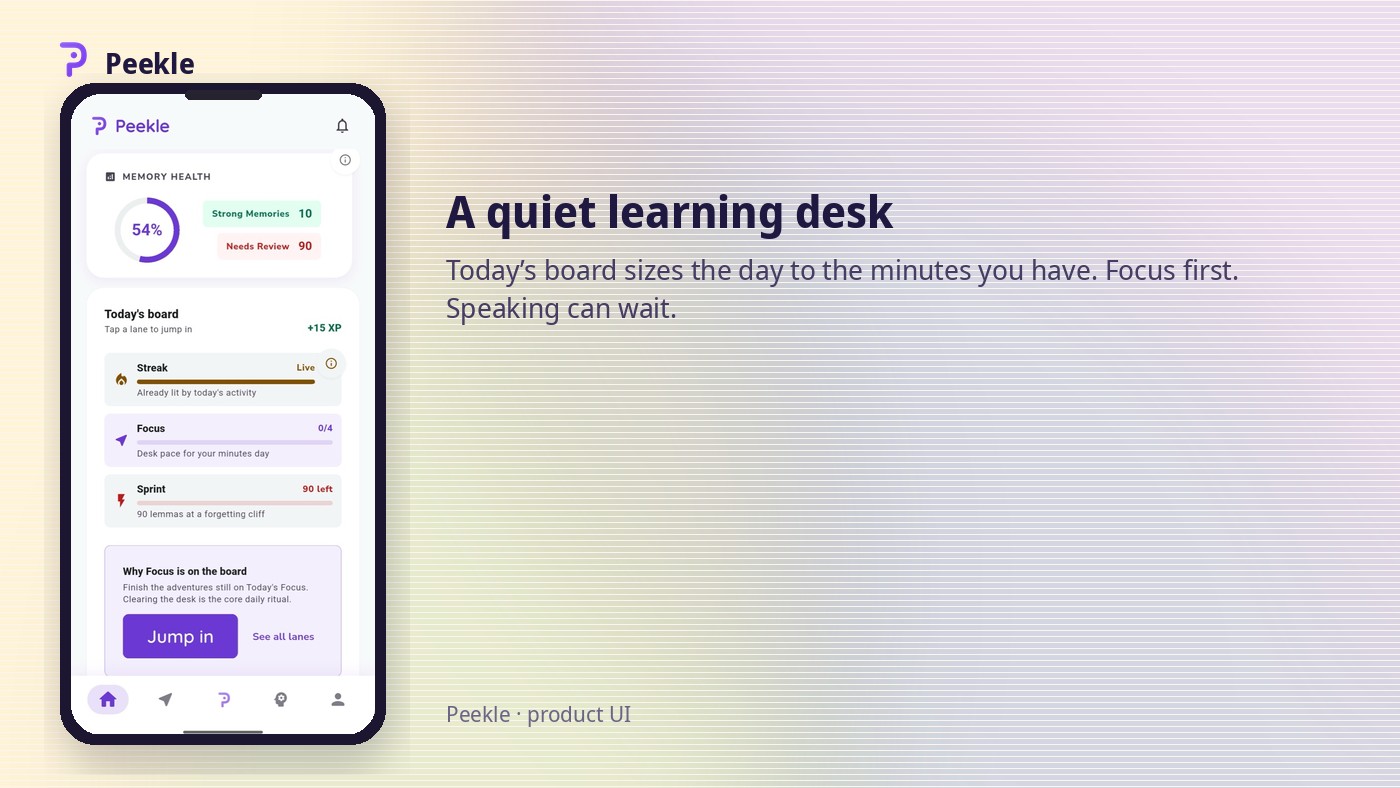
Peekle is a free personal learning desk for real situations: short adventures with a goal, Memory tied to the sentence you met a word in, writing from memory when it is your turn, and honest help when you are stuck. You can size the day to the time you have. You can explore what others share when you want company, without a loud practice circle.
Peekle is not a speaking or pronunciation coach. You can hear lines with text-to-speech; speech is not graded. There is no conversation partner scoring your voice. The point of this path is knowing, writing, and understanding first, so speaking, if and when you choose it, is not the only way in.
For the retrieval side of the same story, see why remembering beats recognizing. For productive struggle with honest help, see a little hard on purpose. Turkish readers: Dil bilmek, dil konuşmak demek değil.
Quiet practice can still be serious practice
Active recall still matters when you write. Pulling a line from memory beats empty recognition. Comprehensible input still matters when a new scene arrives with honest scaffolding. A little desirable difficulty (hard enough to learn, help enough so stuck is not a brick) still builds knowing without a microphone.
None of that needs a loud room. It needs a finishable situation, a memory that returns, and help that does not pretend you did it alone.
Speaking can wait
If speaking feels hard, Peekle is a stop before speaking, or a place to stay until you choose otherwise. Not anti-speaking forever. Honest that knowing can come first.
Build the knowing. Keep the desk. Speaking can wait.